
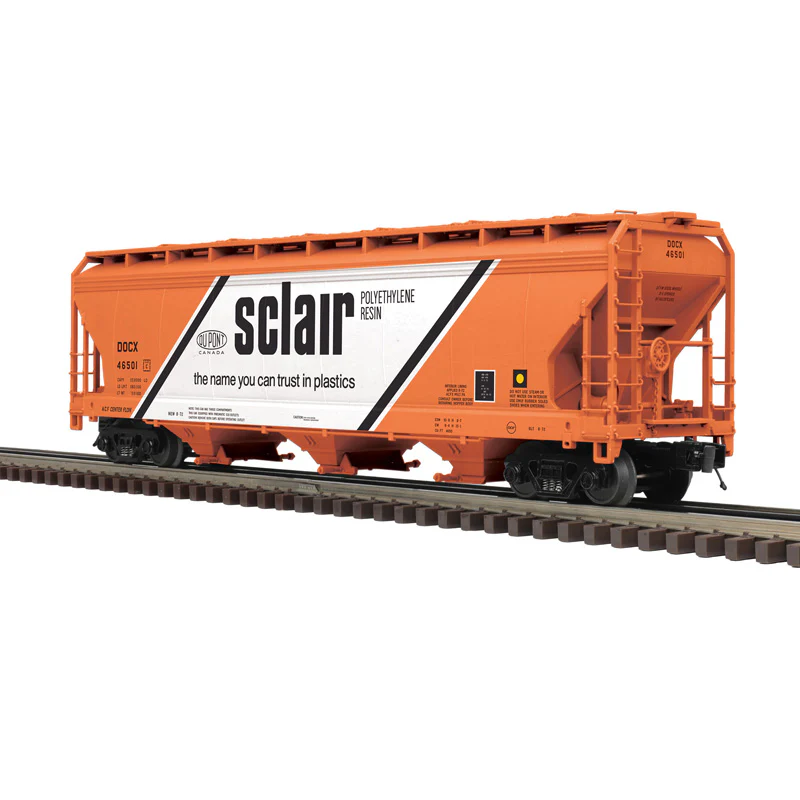
Atlas O 3001627 - Premier - ACF 3-Bay Centerflow Hopper Car "Sclair"
| Announced Date: | Oct 2023 |
| Released Date: | Mar 2025 |
| Individually Boxed: | No - 4 to a case |
- Road Name: Sclair
- Road Number: 46501, 46515
- Product Line: Master
- Scale: O Scale
- System: 3-Rail
Features:
- Intricately Detailed Durable ABS Body
- Metal Wheels and Axles
- Die-Cast 4-Wheel Trucks
- Operating Die-Cast Metal Couplers
- Colorful, Attractive Paint Schemes
- Fast-Angle Wheel Sets
- Needle-Point Axles
- 1:48 Scale Dimensions
- Unit Measures:13 7/8” x 2 11/16” x 3 7/8”
- Operates On O-31 Curves (3-Rail)
Overview:
Although covered hoppers had achieved widespread use by the 1950s, it wasn’t until the following decade that they began to carry North America’s grain harvest. Prior to the 1960s, U.S. and Canadian farmers sent their wheat and other grains to market in 40’ box cars. All that changed with American Car and Foundry’s (ACF’s) introduction of the Centerflow covered hopper in 1961, followed the next year by Pullman-Standard’s competitive PS-2CD covered hopper. Prior to the Centerflow, the typical covered hopper was little more than a coal hopper with a roof. Dry products such as salt were loaded through roof hatches and unloaded by gravity through doors in the floor. Like most freight cars of their era, these cars had a center sill that led to problems in emptying the car. Typically some of the load would cake or “bridge” on the center sill, and the car would have to be vibrated to loosen the mess and achieve full unloading. This vibration tended to shorten the life of the car.
The Centerflow’s key innovation was the elimination of the center sill by relocating the car’s main support beams to the bottom edge of each side. This enabled the discharge hopper doors to be located along the centerline of the car, allowing for easier, more complete unloading and banishing the problem of caking on the center sill. The Centerflow was the first larger-capacity covered hopper designed for grain and products of similar density. By the 1980s, ACF’s Centerflow, along with covered grain hoppers from other builders, had spelled the end of the 40’ box car in grain service. In addition to grain, Centerflows found work hauling a variety of other light to medium-density dry commodities, including salt, clay, chemicals, phosphates and other minerals.
Original: $79.95
-70%$79.95
$23.98More Images

Atlas O 3001627 - Premier - ACF 3-Bay Centerflow Hopper Car "Sclair"
| Announced Date: | Oct 2023 |
| Released Date: | Mar 2025 |
| Individually Boxed: | No - 4 to a case |
- Road Name: Sclair
- Road Number: 46501, 46515
- Product Line: Master
- Scale: O Scale
- System: 3-Rail
Features:
- Intricately Detailed Durable ABS Body
- Metal Wheels and Axles
- Die-Cast 4-Wheel Trucks
- Operating Die-Cast Metal Couplers
- Colorful, Attractive Paint Schemes
- Fast-Angle Wheel Sets
- Needle-Point Axles
- 1:48 Scale Dimensions
- Unit Measures:13 7/8” x 2 11/16” x 3 7/8”
- Operates On O-31 Curves (3-Rail)
Overview:
Although covered hoppers had achieved widespread use by the 1950s, it wasn’t until the following decade that they began to carry North America’s grain harvest. Prior to the 1960s, U.S. and Canadian farmers sent their wheat and other grains to market in 40’ box cars. All that changed with American Car and Foundry’s (ACF’s) introduction of the Centerflow covered hopper in 1961, followed the next year by Pullman-Standard’s competitive PS-2CD covered hopper. Prior to the Centerflow, the typical covered hopper was little more than a coal hopper with a roof. Dry products such as salt were loaded through roof hatches and unloaded by gravity through doors in the floor. Like most freight cars of their era, these cars had a center sill that led to problems in emptying the car. Typically some of the load would cake or “bridge” on the center sill, and the car would have to be vibrated to loosen the mess and achieve full unloading. This vibration tended to shorten the life of the car.
The Centerflow’s key innovation was the elimination of the center sill by relocating the car’s main support beams to the bottom edge of each side. This enabled the discharge hopper doors to be located along the centerline of the car, allowing for easier, more complete unloading and banishing the problem of caking on the center sill. The Centerflow was the first larger-capacity covered hopper designed for grain and products of similar density. By the 1980s, ACF’s Centerflow, along with covered grain hoppers from other builders, had spelled the end of the 40’ box car in grain service. In addition to grain, Centerflows found work hauling a variety of other light to medium-density dry commodities, including salt, clay, chemicals, phosphates and other minerals.
Product Information
Product Information
Shipping & Returns
Shipping & Returns
Description
| Announced Date: | Oct 2023 |
| Released Date: | Mar 2025 |
| Individually Boxed: | No - 4 to a case |
- Road Name: Sclair
- Road Number: 46501, 46515
- Product Line: Master
- Scale: O Scale
- System: 3-Rail
Features:
- Intricately Detailed Durable ABS Body
- Metal Wheels and Axles
- Die-Cast 4-Wheel Trucks
- Operating Die-Cast Metal Couplers
- Colorful, Attractive Paint Schemes
- Fast-Angle Wheel Sets
- Needle-Point Axles
- 1:48 Scale Dimensions
- Unit Measures:13 7/8” x 2 11/16” x 3 7/8”
- Operates On O-31 Curves (3-Rail)
Overview:
Although covered hoppers had achieved widespread use by the 1950s, it wasn’t until the following decade that they began to carry North America’s grain harvest. Prior to the 1960s, U.S. and Canadian farmers sent their wheat and other grains to market in 40’ box cars. All that changed with American Car and Foundry’s (ACF’s) introduction of the Centerflow covered hopper in 1961, followed the next year by Pullman-Standard’s competitive PS-2CD covered hopper. Prior to the Centerflow, the typical covered hopper was little more than a coal hopper with a roof. Dry products such as salt were loaded through roof hatches and unloaded by gravity through doors in the floor. Like most freight cars of their era, these cars had a center sill that led to problems in emptying the car. Typically some of the load would cake or “bridge” on the center sill, and the car would have to be vibrated to loosen the mess and achieve full unloading. This vibration tended to shorten the life of the car.
The Centerflow’s key innovation was the elimination of the center sill by relocating the car’s main support beams to the bottom edge of each side. This enabled the discharge hopper doors to be located along the centerline of the car, allowing for easier, more complete unloading and banishing the problem of caking on the center sill. The Centerflow was the first larger-capacity covered hopper designed for grain and products of similar density. By the 1980s, ACF’s Centerflow, along with covered grain hoppers from other builders, had spelled the end of the 40’ box car in grain service. In addition to grain, Centerflows found work hauling a variety of other light to medium-density dry commodities, including salt, clay, chemicals, phosphates and other minerals.